Find out about the pegword mnemonic
Here are pegwords I've thought up in the Spanish language.
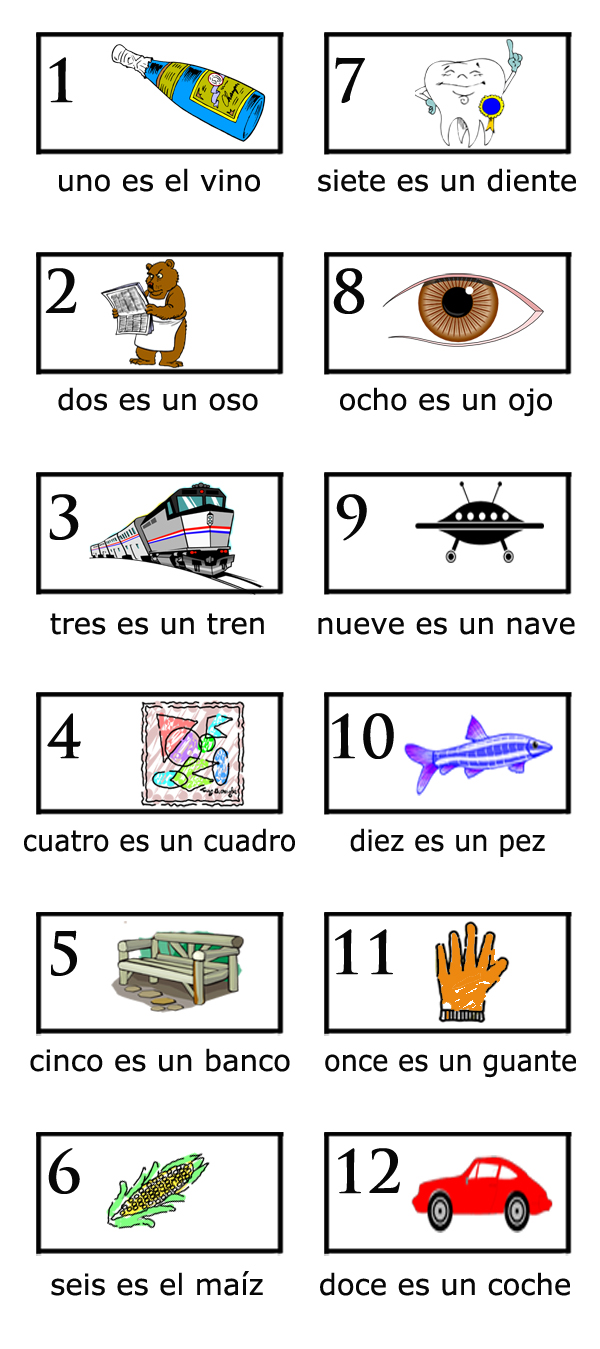
As with the original example, let's try it out with our cranial nerves.
En español, los nervios craneales son:
Find out about the pegword mnemonic
Here are pegwords I've thought up in the Spanish language.
As with the original example, let's try it out with our cranial nerves.
En español, los nervios craneales son:
Most mnemonic strategies use visual images. But as I say in The myth of imagery, while there is no doubt that imagery can be an effective tool, there is nothing particularly special about it. The advantage of imagery is that it provides an easy way of connecting information that is not otherwise readily connected. However, providing verbal links can be equally effective.
In the mid-seventies, Raugh and Atkinson had remarkable results using the keyword method to teach Russian vocabulary to college students. While later studies have not tended to find such dramatic results, nevertheless, a large number of studies have demonstrated an advantage in using the keyword mnemonic to learn vocabulary.
Some researchers have become huge fans of the strategy. Others have suggested a number of limitations. Let’s look at these.
Retrieval practice, as its name suggests, is a simple strategy that involves retrieving the target information one or more times prior to testing. It is not the same as repetition or rehearsal! The idea is not to simply repeat the correct information, but to try and retrieve it. Feedback as to the correct answer may or may not follow.
Children learn. It’s what they do. And they build themselves over the years from wide-eyed baby to a person that walks and talks and can maybe fix your computer, so it’s no wonder that we have this idea that learning comes so much more easily to them than it does to us. But is it true?
There are two particular areas where children are said to excel: learning language, and learning skills.
The Seattle Longitudinal Study of Adult Intelligence has followed a group of more than 5000 people for well over four decades. The program began in 1956 and participants have been tested across a whole gamut of mental and physical abilities at seven year intervals since that date.
The study has found:
Alzheimer's disease currently affects one in 10 people over age 65 and nearly half of those over age 85.
More than 19 million Americans say they have a family member with the disease, and 37 million say they know somebody affected with Alzheimer's.
In the United States, the average lifetime cost per Alzheimer patient is US$174,000. (These figures are from the U.S. Alzheimer's Association).
First-letter mnemonics are, as their name suggests, memory strategies that use the initial letters of words as aids to remembering. This can be an effective technique because initial letters are helpful retrieval cues, as anyone who has endeavored to remember something by mentally running through the letters of the alphabet can attest to.
There are two types of first-letter mnemonic:
It is clear that there are differences between the genders in terms of cognitive function; it is much less clear that there are differences in terms of cognitive abilities. Let me explain what I mean by that.
It's commonly understood that males have superior spatial ability, while females have superior verbal ability. Males are better at math; females at reading. There is some truth in these generalizations, but it's certainly not as simple as it is portrayed.
Brain autopsies have revealed that a significant number of people die with Alzheimer’s disease evident in their brain, although in life their cognition wasn’t obviously impaired. From this, the idea of a “cognitive reserve” has arisen — the idea that brains with a higher level of neuroplasticity can continue to work apparently normally in the presence of (sometimes quite extensive) brain damage.