Traumatic brain injury is the biggest killer of young adults and children in the U.S., and in a year more Americans suffer a TBI than are diagnosed with breast, lung, prostate, brain and colon cancer combined. There are many causes of TBI, but one of the more preventable is that of sports concussion.
Articles
Song is a wonderful way to remember information, although some songs are better than others. Songs that help you remember need to have simple tunes, with a lot of repetition -- although a more complex tune can be used if it is very familiar. Most importantly, the words should be closely tied to the tune, so that it provides information about the text, such as line and syllable length. You can read more about this in my article on Music as a mnemonic aid, but here I simply want to mention a few specific songs designed for teaching facts.
Broadly speaking, a concept map is a graphic display that attempts to show how concepts are connected to each other. A concept map is a diagram in which labeled nodes represent concepts, and lines connecting them show the relationships between concepts.
There is one type of concept map you’re probably all aware of — mind maps. Mind maps are a specialized form of concept map popularized very successfully by Tony Buzan.
A mind map has four essential characteristics:
Does photographic memory exist?
"Photographic" or eidetic memory is said to occur in some 8% of children, but almost all of these grow out of it. The phenomenon is extremely rare in adults, and indeed the very existence of photographic memory is still somewhat contentious. However, it may be that particular brain abnormalities can lead to ways of processing information that are dramatically different from the normal (see the case of Kim Peek).
Some personal experience
I have two sons. One of them was a colicky baby. Night after night my partner would carry him around the room while I tried to get a little sleep. One night, for his own amusement, my partner chose a particular CD to play. Magic! As the haunting notes of the hymns of the 12th century abbess Hildegard of Bingen rang through the room, the baby stopped crying. And stayed stopped. As long as the music played. Experimentation revealed that our son particularly liked very early music (plainchant from the 15th century Josquin des Pres was another favorite).
I’ve recently had a couple of thoughts about flow — that mental state when you lose all sense of time and whatever you’re doing (work, sport, art, whatever) seems to flow with almost magical ease. I’ve mentioned flow a couple of times more or less in passing, but today I want to have a deeper look, because learning (and perhaps especially that rewiring I was talking about in my last post) is most easily achieved if we can achieve "flow" (also known as being ‘in the zone’).
Let’s start with some background.
Are you right-brained or left-brained?
One of the dumber questions around.
I think it’s safe to say that if you only had one hemisphere of your brain, you wouldn’t be functioning.
Of course, that’s not the point. But the real point is little more sensible. The whole idea of right brain vs left brain did come out of scientific research, but as is so often the case, the myth that developed is light years away from the considerably duller scientific truths that spawned it.
There hasn't been a lot of research into the effects of herbs and spices on cognition and the brain, unfortunately. But on the positive side, the risk of side-effects is very low, so we don't need a lot of evidence for it to be worth trying.
Find out about the pegword mnemonic
Here are pegwords I've thought up in the Spanish language.
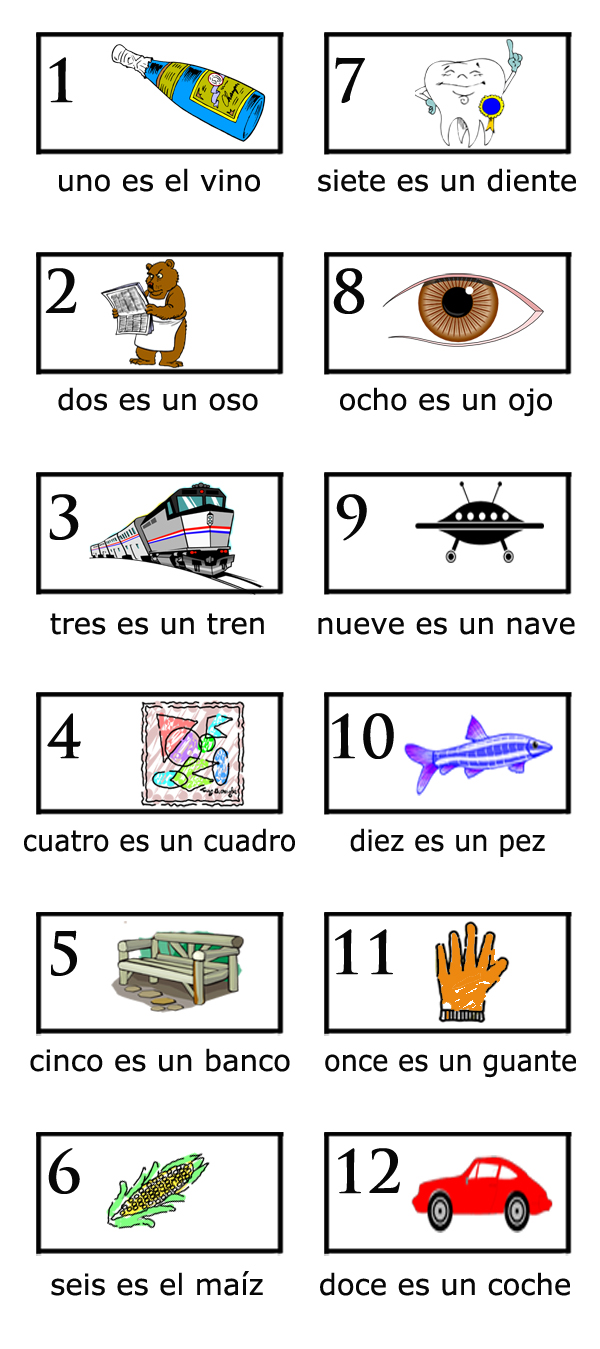
As with the original example, let's try it out with our cranial nerves.
En español, los nervios craneales son:
As we all know, we are living in a time of great changes in education and (in its broadest sense) information technology. In order to swim in these new seas, we and our children need to master new forms of literacy. In this and the next three posts, I want to explore some of the concepts, applications, and experiments that bear on this.