As I said in my discussion of different scripts, the Hellenic languages use the Greek alphabet. Here it is. I’m afraid the table is a little complicated, because (a) each letter has a name, which it’s useful to know, and (b) there are some differences in pronunciation between Ancient Greek (which is still a language that people want to learn today), and Modern Greek.
Articles
Find out about the pegword mnemonic
Here are pegwords I've thought up in the Spanish language.
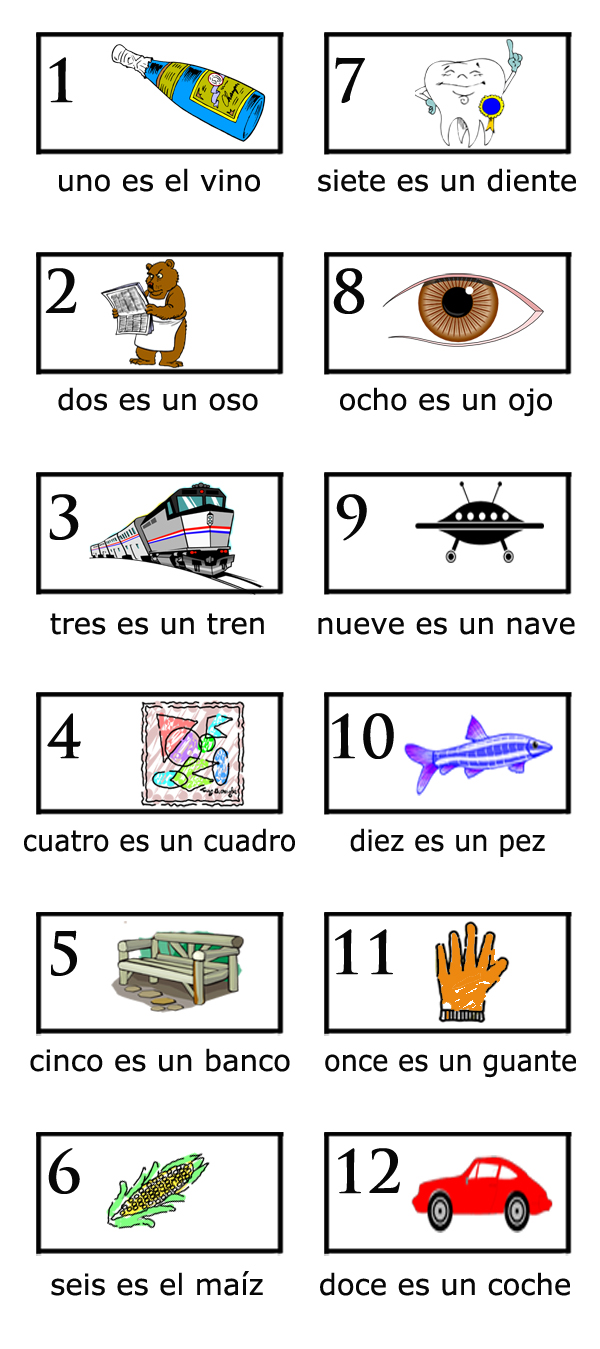
As with the original example, let's try it out with our cranial nerves.
En español, los nervios craneales son:
Brain tissue is divided into two types: gray matter and white matter. These names derive very simply from their appearance to the naked eye. Gray matter is made up of the cell bodies of nerve cells. White matter is made up of the long filaments that extend from the cell bodies - the "telephone wires" of the neuronal network, transmitting the electrical signals that carry the messages between neurons.
The volume of gray matter tissue - a measure you will see cited in various reports - is a measure of the density of brain cells in a particular region.
Most people believe that an adult learner can't hope to replicate the fluency of someone who learned another language in childhood. And certainly there is research to support this. However, people tend to confuse these findings - that the age of acquisition affects your representation of grammar - with the idea that children can learn words vastly quicker than adults. This is not true. Adults have a number of advantages over children:
"Consolidation" is a term that is bandied about a lot in recent memory research. Here's my take on what it means.
Becoming a memory
Initially, information is thought to be encoded as patterns of neural activity — cells "talking" to each other. Later, the information is coded in more persistent molecular or structural formats (e.g., the formation of new synapses). It has been assumed that once this occurs, the memory is "fixed" — a permanent, unchanging, representation.
Compulsory Education: When it starts and how long it lasts
Around the world, for the most part, compulsory schooling starts at 6, although some start at 7, and a very few at 5 or even younger. There is less consensus about how long compulsory education should last, but 9 years is the most common length, with 10 years running a close second.
There hasn't been a lot of research into the effects of herbs and spices on cognition and the brain, unfortunately. But on the positive side, the risk of side-effects is very low, so we don't need a lot of evidence for it to be worth trying.
There is a very common form of forgetfulness that is not really a failure of memory. When we get in our car to drive to place A and find ourselves instead on the road to the more familiar place B, this is not a failure of memory. When we clear the table and find ourselves putting the margarine in the dishwasher or the dirty plate in the fridge, this is not a failure of memory. When we go into a room intending to do one thing and do something else instead, this is not, really, a failure of memory.
In the mid-seventies, Raugh and Atkinson had remarkable results using the keyword method to teach Russian vocabulary to college students. While later studies have not tended to find such dramatic results, nevertheless, a large number of studies have demonstrated an advantage in using the keyword mnemonic to learn vocabulary.
Some researchers have become huge fans of the strategy. Others have suggested a number of limitations. Let’s look at these.
Many parents enrol their children in Montessori preschools because they are an "educational" way of getting childminding - if you're going to put your child in a creche, why not put them in a preschool instead - or because they want to give their child a "head start" on education. Quality preschool education is a rarity and Montessori are certainly leaders in the field.